 Daniel Vos
Airport dressing involves managing three things at once: temperature swings in the waiting area, ease of taking clothes on and off for security and boarding, and room to move when handling luggage. The corteiz jacket can serve as your outer layer core, but you can't base the whole outfit on looks alone. A safer approach is to first check the style, color, size, and visible material details on the fashion-reps product page, then choose your mid-layer and bottoms according to flight length, destin
Editor score 4.2 / 5
Airport dressing involves managing three things at once: temperature swings in the waiting area, ease of taking clothes on and off for security and boarding, and room to move when handling luggage. The corteiz jacket can serve as your outer layer core, but you can't base the whole outfit on looks alone. A safer approach is to first check the style, color, size, and visible material details on the fashion-reps product page, then choose your mid-layer and bottoms according to flight length, destination temperature, and luggage capacity.
This article focuses on one specific task: turning a single corteiz jacket into a layered outfit suitable for fall-winter airport travel. By the end, you should be able to pick one of three combinations and complete the product page verification, luggage trade-offs, and pre-boarding layering plan. If you need to confirm actual warmth level, water resistance, fill composition, or fit, page text and mockups alone are not enough—you must go back to the visible product page information and later physical inspection. ✈️
Data note: This article uses the fashion-reps product data and reference prices provided in the manuscript. Price records were verified on 2026-10-11. Inventory, color options, size availability, material labeling, and page status may change; revisit the product page before saving or ordering.
What This corteiz Jacket Airport Outfit Solves
The goal is not to pile on as many clothes as possible, but to find adjustable layers that work between outdoor cold, indoor airport heating, security lines, and luggage handling. The outer layer handles wind and quick on-off, the mid-layer adds warmth, the base layer provides next-to-skin comfort, and the bottoms and shoes determine how easy it is to walk for long periods.
Airport settings especially call for avoiding excessive bulk. Too many clothes eat into carry-on space, overly baggy hoodies can make seat belts, backpack straps, and seat backs uncomfortable; heavy soles or overly thick shoe shapes also add burden during security checks and connecting walks.
Therefore, the selection order can be fixed as:
- First determine the lowest temperature at your destination and during the flight, then decide mid-layer thickness.
- Next, check if the jacket's size can accommodate a knit or hoodie without noticeably limiting arm raises and backpack movement.
- Finally, choose pants style and shoes to ensure natural movement when sitting, bending, and retrieving luggage.
Verify Style, Color, Size, and Visible Materials on the fashion-reps Product Page
The outer layer available for reference in the current data is a corteiz zip-front cotton puffer jacket listed across a wide colorway run, with a product page reference price of $21.79. "Cotton" and "puffer" are page descriptions from the listing data, and you cannot infer fill ratio, warmth level, fabric water resistance, or actual weight from them.
Before saving, check in this order:
- Style: confirm whether it's a zip-front, short or long cut, and check if the collar, cuffs, and hem will conflict with the mid-layer.
- Color: prioritize colors that can be recombined with existing pants and shoes to reduce the need to carry extra accessories for one jacket.
- Size: measure your shoulder width, chest, sleeve length, and body length against the product page size chart; don't just buy your usual letter size.
- Material: record only what the page explicitly states; do not add fill, lining, abrasion resistance, or water resistance if not mentioned.
- Page status: confirm the product name, price, selectable options, and visible images still exist; avoid treating dead, empty, or label-only pages as purchase evidence.
| Reference Item | Price on Page Data | Airport Outfit Role |
|---|---|---|
| Corteiz zip-front cotton puffer jacket, multi-color options | $21.79 | As outer layer, easy on-off for indoor-outdoor temperature changes |
| Corteiz cotton printed loose shorts with insulated lining description | $27.54 | Only for warmer, low-mobility travel scenarios; not default bottoms for fall-winter airport |
| Louis Vuitton x Park Seo-Bo Trainer Maxi leather chunky sneaker | $102.09 | Provides noticeable upper proportions, but weight and long-distance walking comfort need careful assessment |
Prices are only for this outfit budget reference and do not represent stock, shipping, taxes, storage fees, or final landed cost. Information not provided on the product page should not be extrapolated from titles or images.
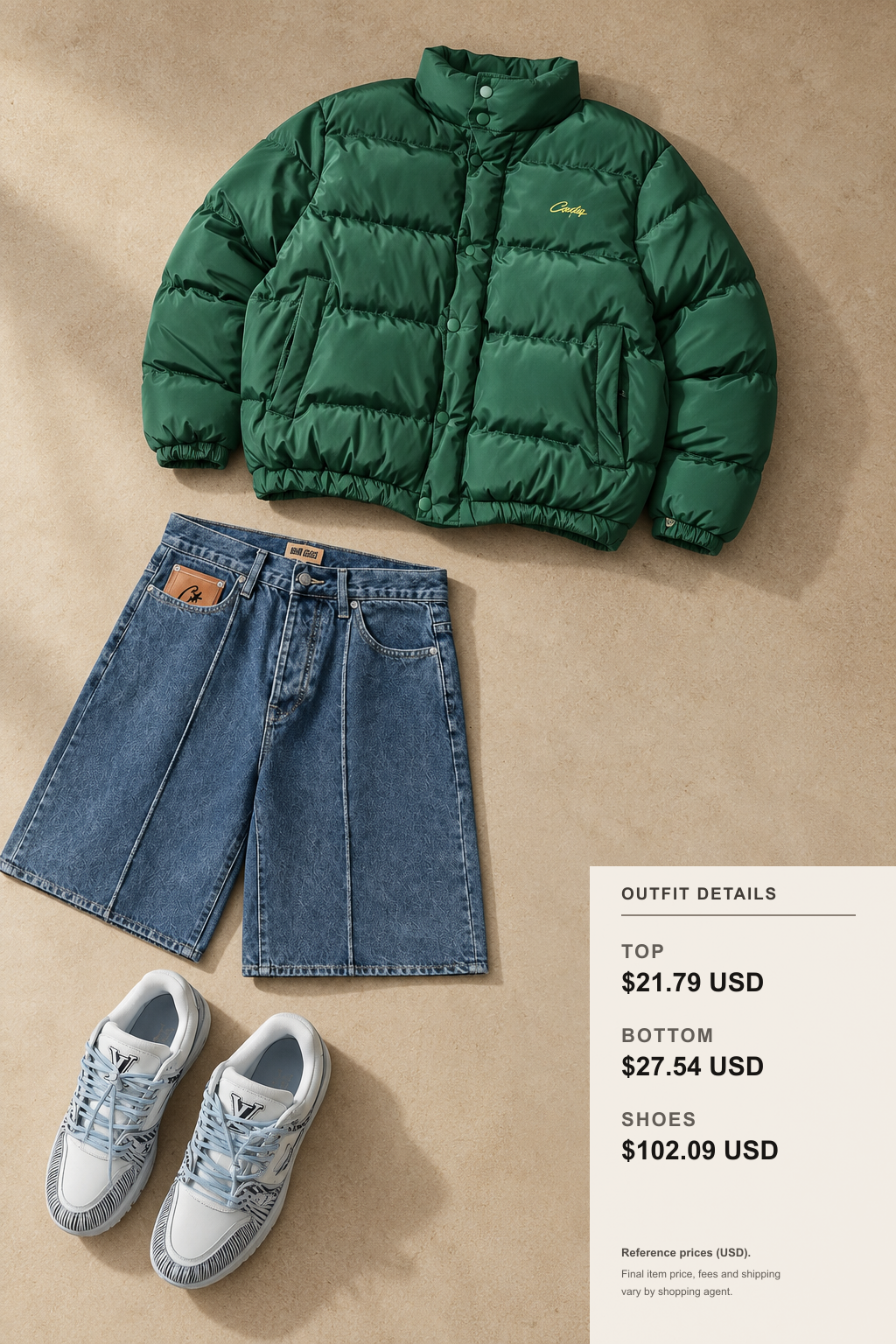
Caption: Airport travel outfit reference with jacket, bottoms, and sneakers; focus on color proportion and luggage packing relationship.
Option 1: Jacket with Knit Layer, Straight-Leg Pants, and Walkable Shoes
This is the safest fall-winter airport combination among the three options. A thin knit provides a more stable base temperature than short sleeves, straight-leg pants won't easily catch on seat armrests, suitcase handles, or security equipment like overly loose styles, and shoes should be chosen for long walking comfort.
Layer logic:
- Base layer: thin long-sleeve top or lightweight knit, avoid bulk at armpits and shoulders.
- Mid-layer knit: choose one that doesn't extend much past the jacket cuffs, so sleeves can be tucked inside.
- Bottoms: straight-leg pants balance the jacket's volume; colors like black, dark gray, or dark blue reduce visual load.
- Shoes: prioritize stable soles, moderate weight, and easy on/off.
If you choose the Louis Vuitton x Park Seo-Bo Trainer Maxi from the data, treat it as an option with prominent appearance and volume, not a default lightweight shoe. The listing describes it as a padded, chunky white sneaker that fits large, but page information is insufficient to prove suitability for long-distance walking. Before departure, judge with sole weight, instep space, and your own walking habits.
This option suits people with connecting flights, frequent luggage retrieval, or cold outdoor destination temperatures. The trade-off is that knit layers usually take more space than thin base layers; when packing, fold neatly or wear them on the plane.
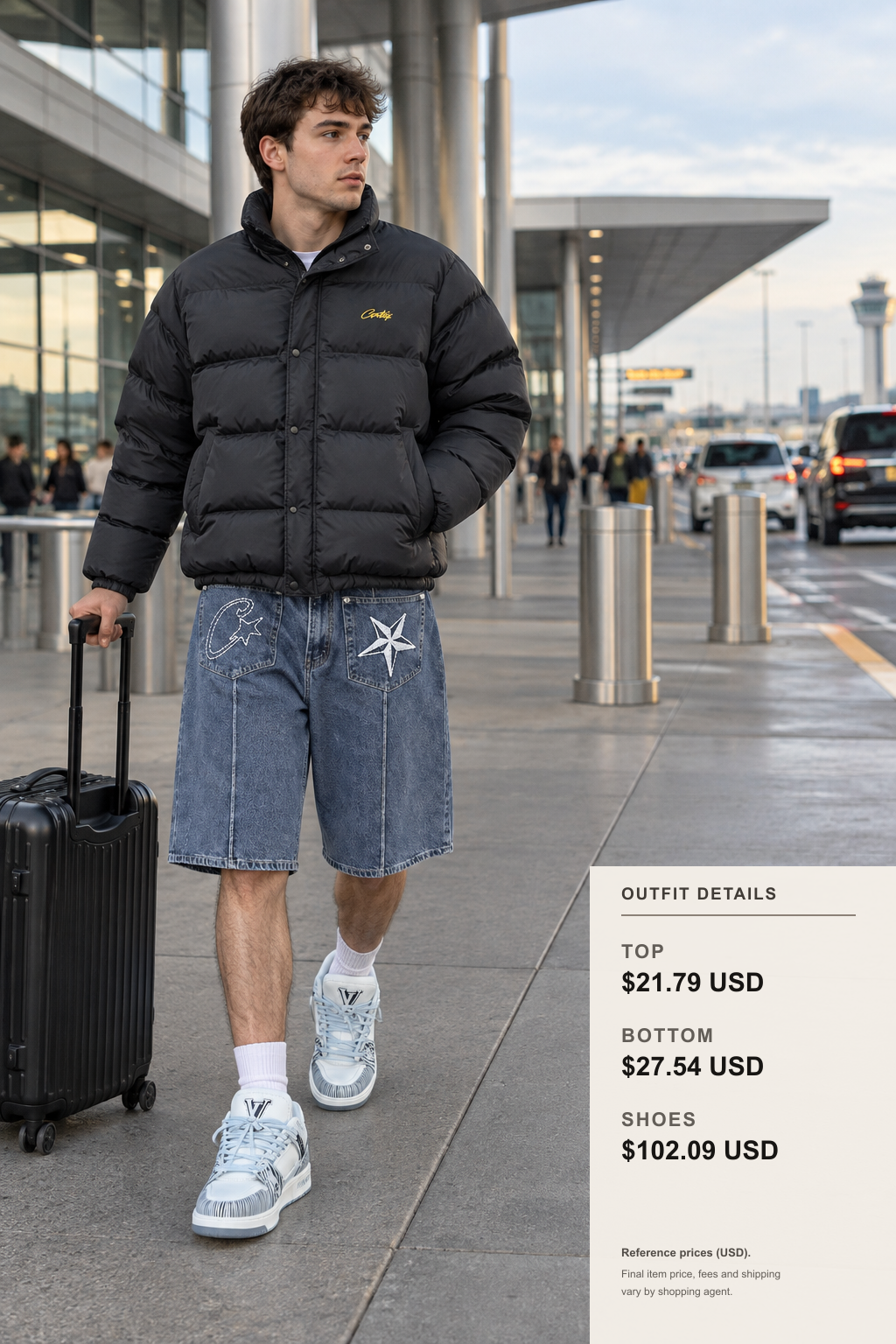
Caption: Full-body proportion reference, jacket outer layer and straight-leg bottoms maintain clear layering, suitable for switching between waiting and walking.
Option 2: Jacket with Hoodie, Relaxed Pants, and Lightweight Shoes
This option emphasizes comfort and adjustability. A hoodie is good for long flights or waiting periods, but the hood, drawstrings, and thick front pocket may bunch with the jacket collar or backpack straps, so control layers and volume.
Styling notes:
- Choose a medium-weight hoodie; don't let hood and collar pile up at the jacket's high collar position.
- Relaxed pants should leave enough hem room to avoid stepping on cuffs or catching luggage wheels.
- Shoes: lightweight with stable wrap; don't add sole volume just to match the loose pants.
- Keep passport, boarding info, and earphones in an easily accessible outer pocket or small bag; don't let jacket pockets carry all storage duties.
This option is comfortable for indoor waiting and lets you take off the hoodie and put it in a backpack. However, it's not necessarily right for very cold conditions requiring long outdoor waits, because loose doesn't equal warm; the jacket's actual insulation still depends on clear product page data and physical verification.
If you plan to carry many souvenirs or need to compress luggage, a hoodie takes more space than a thin knit. In that case, wear the hoodie and use the jacket as outer layer to avoid extra suitcase volume.
Option 3: Jacket with Thin Base, Jeans, and Scarf Accessory
This option suits those who don't want a heavy mid-layer but want to adjust warmth with accessories. Thin base and jeans are easy to pack, and a scarf can quickly add neck coverage between waiting areas, plane cabins, and outdoor arrival environments.
The advantage is less luggage and simpler on/off, good for short trips or destinations with stable temperatures. The downside is that a scarf only provides localized coverage and cannot replace a full insulating mid-layer; if the jacket's warmth info is incomplete, this option cannot be considered sufficient for cold-weather travel.
Jeans need special attention to waist and knee mobility. Common airport actions include sitting for long periods, squatting to organize luggage, and stepping over suitcases; if pants are too tight, comfort drops noticeably. The scarf should not be too long, to avoid catching on luggage carts, escalators, or seats.
This combination is better for light packers, especially those with only a small personal bag who want to save space for other items. If the destination requires outdoor stays, add a compressible insulating layer in your luggage rather than relying only on a scarf.
How the Three Layering Options Balance Boarding, Waiting, and Luggage Access
Break down the three options by scenario:
| Scenario | Better Option | Main Reason | Trade-off to Accept |
|---|---|---|---|
| Long layovers, lots of airport walking | Option 1 | More complete temperature layers; straight-leg pants and stable shoes help mobility | Knit layer takes more space; shoes still need individual weight assessment |
| Long waiting times, prioritize seated comfort | Option 2 | Hoodie offers soft mid-layer; relaxed pants give more movement room | Collar and hood prone to bunching; hoodie uses luggage space |
| Short trip, light packing, mild temperature differences | Option 3 | Thin base and jeans easy to pack; scarf allows quick adjustment | Localized warmth can't replace full mid-layer; not for cold prolonged standing |
Before boarding, adopt the method: "outer layer worn, mid-layer packable, documents stored separately." Before security, check pockets for metal and small items that may fall out; when taking off the jacket, put scarf, earphones, and documents in a fixed place first to avoid rummaging at the conveyor belt.
When handling luggage, jacket pockets should hold only light, crush-resistant items. Passport, phone, payment device, and important documents go in a zippered small bag; don't stuff everything into jacket pockets. That way, even if you need to remove the jacket, go through security, or pack it in a suitcase, important items won't lose their fixed spot. 🧳
Which Warmth, Comfort, and Protection Judgments Must Return to Product Evidence
Outfit analysis helps you arrange layers but cannot replace product verification. The following judgments must go back to the product page or later physical inspection:
- Whether the jacket truly contains the fill structure described on the page, and what the fill ratio is.
- Whether the fabric is water-repellent, windproof, or abrasion-resistant; if not stated on the page, don't assume it.
- Whether the size works for layering; don't judge solely from model photos or your usual size.
- Whether zipper, cuffs, hem, and pockets suit frequent on/off and luggage handling.
- Whether the shoes are too heavy, oversized, or need a long break-in; appearance images are not comfort evidence.
- Whether colors and prints match the page options; don't treat mockups as actual stock confirmation.
Before completing a save or purchase on fashion-reps, check item by item: product page accessible, clear name, visible specs, price recorded, size chart complete, images and text consistent. If something is missing, note the uncertainty first, then decide whether to proceed, rather than filling in missing info with common sense. 🔎
Source Image Product Info and Reference Prices
| Outfit Position | Product Title | Product Link | Reference Price |
|---|---|---|---|
| Top | Corteiz zip-front cotton puffer listed across a wide colorway run | View item | $21.79 |
| Bottom | Corteiz Blue Shorts: Cotton Print Shorts in a Loose Cut | View item | $27.54 |
| Shoes | Louis Vuitton x Park Seo-Bo Trainer Maxi: a padded, chunky white sneaker that fits large | View item | $102.09 |
Prices are reference prices from the product detail page at the time of image generation; check real-time prices via the product links in the table before ordering.
| Styling Role | Product Title | Product Link | Reference Price |
|---|---|---|---|
| Top | Corteiz zip-front cotton puffer listed across a wide colorway run | View product | $21.79 |
| Bottom | Corteiz Blue Shorts: Cotton Print Shorts in a Loose Cut | View product | $27.54 |
| Shoes | Louis Vuitton x Park Seo-Bo Trainer Maxi: a padded, chunky white sneaker that fits large | View product | $102.09 |
Prices were captured from the product pages when the image was generated. Check each linked product page for the latest price before ordering.
Products Used in the Generated Image
| Styling Role | Product Title | Product Link | Reference Price |
|---|---|---|---|
| Top | Corteiz zip-front cotton puffer listed across a wide colorway run | View product | $21.79 |
| Bottom | Corteiz Blue Shorts: Cotton Print Shorts in a Loose Cut | View product | $27.54 |
| Shoes | Louis Vuitton x Park Seo-Bo Trainer Maxi: a padded, chunky white sneaker that fits large | View product | $102.09 |
Prices were captured from the product pages when the image was generated. Check each linked product page for the latest price before ordering.
Final Action: Pre-Save Outfit Checklist for the corteiz Jacket
First choose an option based on your itinerary: many connections and lots of walking → Option 1; long waiting times and comfort priority → Option 2; short trip, light packing, limited temperature differences → Option 3.
Then complete the following checks:
- Confirmed style, color, size chart, and visible material description on the product page.
- Recorded the jacket reference price of $21.79 and know it's not the final landed cost.
- Re-measured according to your own shoulder width, chest, and layering needs, not just using your usual size.
- Checked shoe weight, sole stability, and long-distance walking needs.
- Arranged separate storage for passport, phone, payment device, and boarding info.
- Considered indoor-outdoor temperature differences at airports and prepared a removable or packable mid-layer.
- Listed warmth, waterproofing, fill, and comfort items not stated on the page as pending verification.
If using Option 1, the main savings are avoiding last-minute purchase of extra insulating layers and mid-trip changes; the trade-off is knit layer takes more space and shoes may add luggage or walking burden. It suits cold conditions, many connections, and long movement periods; not for minimal carry-on or people unwilling to carry a mid-layer.
If using Option 2, you add hoodie bulk and collar stacking risk but gain softer wearing during waiting; it suits long sitting waits, but not recommended as the sole combination when you can't confirm jacket insulation and need long outdoor stays.
If using Option 3, you save luggage space and on/off steps but increase risk of insufficient warmth in cold environments; it suits short trips, small temperature differences, and light packing, but not recommended as the only warmth plan for cold destinations.