 Daniel Vos
When buying Alo Yoga style activewear for fall and winter, what really matters is not whether the page title is catchy, but whether this piece can complete your wearing task: whether it's easy to layer as a mid-layer, whether the sizing has verifiable data, whether the page information is sufficient to support placing an order, and whether it's still necessary to keep the candidate after receiving QC photos. This article uses the Alo Yoga brand catalog on FashionReps as the starting point for ve
Editor score 4.2 / 5
When buying Alo Yoga style activewear for fall and winter, what really matters is not whether the page title is catchy, but whether this piece can complete your wearing task: whether it's easy to layer as a mid-layer, whether the sizing has verifiable data, whether the page information is sufficient to support placing an order, and whether it's still necessary to keep the candidate after receiving QC photos. This article uses the Alo Yoga brand catalog on FashionReps as the starting point for verification, focusing on the potential inconsistencies between fit, sizing, page descriptions, and QC photos.
This article does not treat the reference prices, product names, or image observations in the catalog as quality guarantees, nor does it claim to have personally purchased, received, or tested the items. The FashionReps page states that product discovery and comparison occur on its site, while orders, payments, and logistics are handled by external shopping agents chosen by users. Therefore, before placing an order, you still need to re-verify availability, sizing, price, shipping, return/exchange conditions, and destination country restrictions on the product page and agent page. Verification date: October 11, 2026. 🧥
Define the Evaluation Task for Alo Yoga Activewear Fall Layering
The specific question of this evaluation is: Among the Alo Yoga style jackets and pants in the FashionReps catalog, which information can help buyers judge fall/winter layering suitability, and which conclusions must wait until the product page, size chart, or QC photos appear?
After reading, readers should be able to complete four actions:
- Filter out jackets or pants suitable for further viewing from the brand catalog.
- Predict potential crowding or proportion issues when layering based on collar, hood, cuffs, hem, and pant leg structure.
- Use personal existing clothing measurements to compare with the product size chart, rather than choosing a size based solely on height and weight.
- Save product pages and verification records, and pause ordering when QC photos cannot support key judgments.
This article is suitable for users who plan to buy cropped down-style jackets, hooded insulated jackets, or wide-leg sweatpants. It is not suitable for confirming authenticity, actual filling composition, actual warmth level, stretch feel, or long-term durability, as the currently visible catalog information is insufficient to support these conclusions.
Confirm Style, Color, Size, and Visible Material Description from FashionReps Product Pages
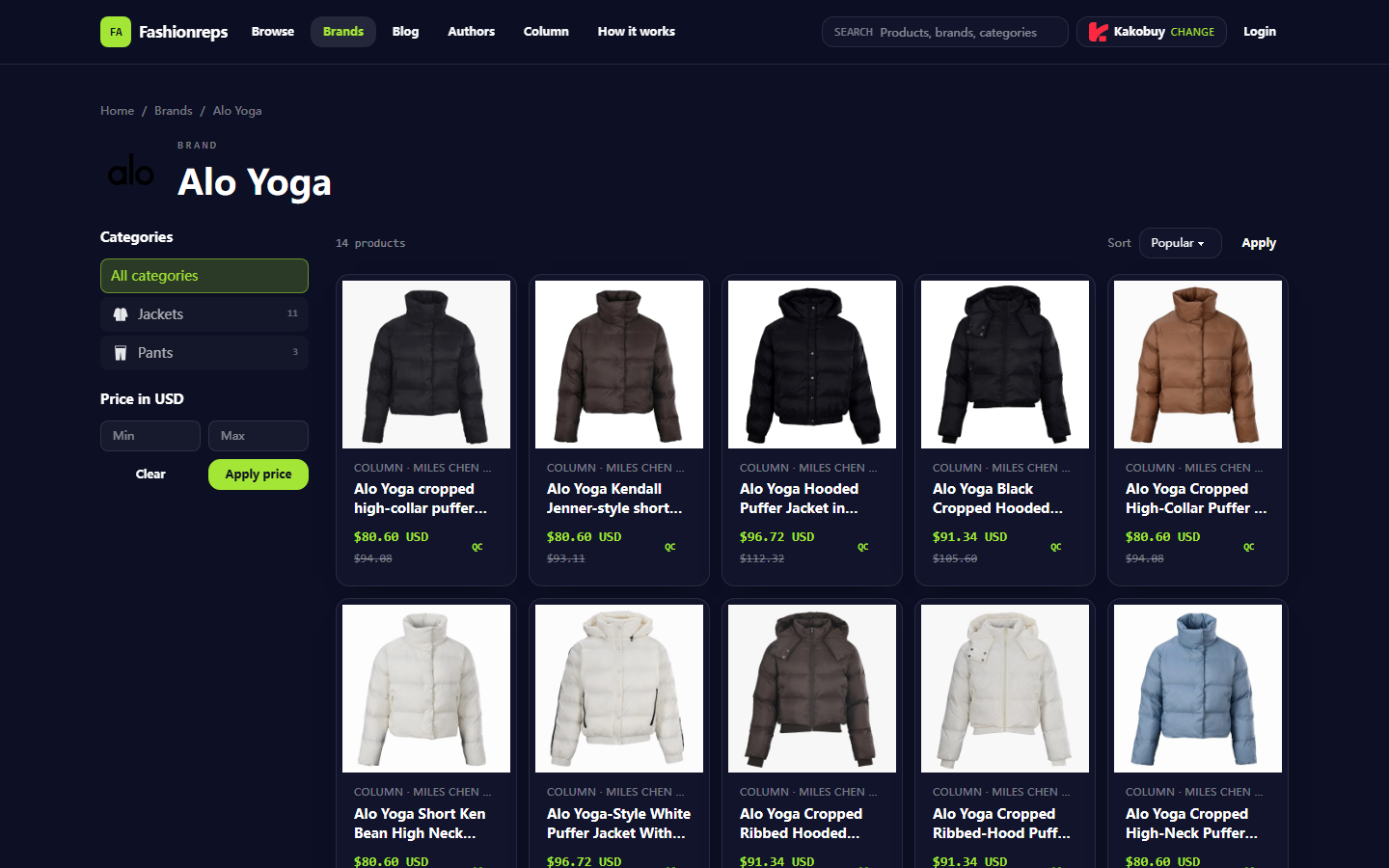
The FashionReps Alo Yoga brand catalog currently shows 14 products, with categories including 11 Jackets and 3 Pants. The visible jacket samples in the catalog are mainly concentrated in cropped, high-collar, hooded, quilted, or down-style designs; the pants include brown wide-leg drawstring pants, black straight-leg casual pants, and gray 350 g loopback terry wide-leg pants.
This information can help buyers build initial candidates, but it cannot replace the product detail page. The product names displayed in the catalog may contain hints about color, cut, decoration, and available sizes, such as "five colorways", "XS–L", or "black, ivory, and baked apricot". These words can only indicate that the page currently shows the corresponding description, and cannot automatically prove that all colors and sizes are still in stock.
After entering a specific product page, it is recommended to record in the following order:
- The complete product page name and product number, if provided.
- The currently displayed color, size, and available variants.
- Whether the page provides flat measurements, a size chart, or seller recommendations.
- Whether the material description specifies fabric, filling, lining, or weight.
- Whether the product images correspond to the text description, and whether there is mixing of multiple styles.
- The reference price, current price, discount conditions, and price currency displayed on the page.
- Whether the product page is accessible normally, or if there are redirects, blank pages, or missing information.
The reference prices in the current catalog range from approximately $32.24 to $96.72, and some entries also show previous reference prices. They should be considered as reference information at the catalog level and should not be directly treated as the final payment amount. Agent service fees, domestic shipping, international shipping, insurance, taxes, and exchange rates may all change the total cost. 💰
| Visible catalog information | Supported judgments | Still need to verify |
|---|---|---|
| Product name and category | Preliminary determination of cropped jacket, hooded jacket, or pants | Actual fit, workmanship, and available variants |
| Color name or number of colors | Establish color candidates and check suitability for pairing | Screen difference from actual color, current inventory |
| Reference price | Compare catalog price levels of different candidates | Final transaction price, shipping, taxes, and agent fees |
| Sizing hints like XS–L | Determine the possible size range offered on the page | Specific length, chest, sleeve length, and inventory for each size |
| Text description like 350 g loopback terry | Record material or weight information explicitly stated on the page | Actual thickness, warmth, feel, and post-wash changes |
Check the Impact of Collar, Cuffs, Hem, and Fit on Layering
Fall/winter layering starts with spatial relations. The advantage of a cropped high-collar jacket is usually a clean hem that doesn't easily compress the visual proportion of inner layers; however, if the inner layer is a thick hoodie or loose knit, the cropped length and high-collar structure may make the chest and shoulder area appear crowded. What can be done here is structural prediction, not directly interpreting catalog images as wearing comfort.
High-collar designs require careful inspection of collar height, closure method, and collar width. If the page only says high-collar without actual collar photos, zipper closure images, or flat measurements, you can only confirm the design direction, not whether it suits layering with scarves, hooded sweatshirts, or thick knits.
For hooded jackets, also observe the relationship between the hood and collar:
- Whether the hood has significant thickness and may overlap with inner hoods.
- Whether the drawstrings or toggles gather near the chin after the collar is closed.
- Whether the shoulders have enough space to accommodate sweatshirt sleeve caps.
- Whether the cuffs are elastic, Velcro, or open structure.
- Whether the hem has a drawstring and whether tightening it reduces inner layer space.
Cuffs and hem affect layering experience more than decorative logos. Cuffs that are too narrow may restrict thick inner layer sleeves, while cuffs that are too wide may let in wind; a jacket with a hem drawstring can adjust the silhouette, but tightening it may also push inner fabric toward the waist. If the page lacks corresponding detail images, buyers should mark these items as to be confirmed rather than adding non-existent specifications for the product.
The layering judgment for pants is different. For wide-leg pants, look at waistband structure, crotch space, hem width, and inseam length; for straight-leg pants, check whether the hem can cover fall/winter shoe tops and whether inner thermal pants will bunch at the knees. The page description of the gray wide-leg pants in the catalog includes 350 g loopback terry, but this only indicates the weight description in public text, and cannot be directly equated to winter thermal pants or windproof pants.
Assess Sizing Risk Using Size Charts and Personal Garment Data
Do not choose fall/winter jackets based solely on height and weight. In layering scenarios, shoulder width, chest circumference, garment length, sleeve length, and inner layer thickness are often more critical than when worn alone. The safest approach is to find a similar jacket you already own that fits well with appropriate space, measure it flat, and compare item by item with the product page dimensions.
It is recommended to save the following personal data:
- Shoulder width: measure the straight-line distance between shoulder seams on both sides.
- Chest width or circumference: confirm whether the seller uses flat half-chest or full chest circumference.
- Garment length: clarify whether it is measured from the collar, shoulder point, or center back.
- Sleeve length: record whether it is measured from the shoulder seam.
- Hem width: particularly applicable to cropped jackets and drawstring designs.
- Waist, front rise, back rise, thigh width, hem width, and inseam: should be checked for both wide-leg and straight-leg pants.
If the product page has no size chart, or the size chart units are unclear, you should not convert XS, S, M, L on the page into fixed chest ranges by yourself. Different sellers and different styles may have significant differences in fit. Just because the page shows XS–L does not mean that every size is suitable for the same layering thickness.
Risk can be divided into three levels:
- Low risk: The product page has a complete size chart, clear measurement definitions, and is close to your existing garment data.
- Medium risk: Size options exist, but key measurements are missing, or images and text information are not fully consistent.
- High risk: Only letter sizes and model photos, no verifiable measurements, and insufficient QC photos.
When you are between two sizes, first determine the primary use. If the jacket needs to accommodate a thick hoodie, prioritize chest width, shoulder width, and armhole, rather than simply enlarging all parts. If it is mainly used as a lightweight mid-layer, an oversized size may cause shoulder drop and hem bunching. Any decision to size up or down should be based on product page measurement data. 📏
Distinguish Between Page Specifications, Image Observations, and Unconfirmable Warmth and Stretch Experience
When evaluating, evidence should be divided into three categories to avoid presenting speculation as fact.
Page specifications are the text, dimensions, colors, materials, or weight information explicitly stated on the product page. For example, if the page states that the gray wide-leg pants are 350 g loopback terry, it can be recorded as a page specification. Image observations are phenomena directly visible from product images or QC photos, such as whether the color matches the selected variant, or whether there are obvious loose threads or misaligned print positions. Unconfirmable experiences include warmth level, fabric softness, stretch recovery, breathability, pilling from friction, and shrinkage after washing.
The following expressions are safer:
- It is acceptable to write "the page describes a wide-leg cut", not "it will definitely make you look slimmer when worn".
- It is acceptable to write "the image shows a high-collar cropped silhouette", not "the collar has excellent warmth retention".
- It is acceptable to write "the page lists 350 g loopback terry", not "suitable for severe cold weather".
- It is acceptable to write "stitching needs to be confirmed via QC photos", not "workmanship has been verified through actual testing".
- It is acceptable to write "a certain color appears in the product image", not "the actual color is exactly the same".
For Alo Yoga style products, also avoid directly writing style similarity as a conclusion on brand authenticity. Names in the FashionReps catalog may use brand names, style descriptions, or design features, but current information is insufficient to confirm authorization, authenticity, or official brand supply chain. Buyers should assess purchase risk based on page disclosures and destination country regulations. 🔍
Verify Color, Stitching, Print, and Order Correspondence in QC Photos
The role of QC photos is to help buyers verify the appearance and obvious issues of a specific order, not to replace material testing or wearing trials. After receiving photos, first confirm whether the product in the images corresponds to the style, color, and size you selected, then observe key structures.
It is recommended to check in this order:
- Compare with order records to confirm product name, color, size, and quantity.
- Check the overall silhouette to confirm it is still the target style, not another variant from the same series.
- Check whether the collar, hood, cuffs, and hem have obvious deformation or asymmetry.
- Check whether zippers, fasteners, drawstrings, and stitching have obvious breakage, detachment, or misalignment.
- Check whether the print, embroidery, logos, or decorative positions basically correspond to the product page display.
- Check whether the fabric surface has obvious stains, damage, creases, or severe wrinkles.
- If the image angle, lighting, or resolution is insufficient to judge a certain item, request additional photos or mark it as unconfirmed.
Do not mistake a flat appearance in QC photos for actual loft, nor treat the color in a single photo as an accurate color swatch. Screen, lighting, compression, and shooting angle can all affect judgment. For pants, also require images that clearly show the waistband, crotch, hem, and full length, otherwise it is impossible to effectively judge wide-leg proportions and obvious structural issues.
If there are conflicts between the product page, order records, and QC photos, pause confirmation of receipt or continued shipping, and first check with the agent or seller. Do not assume conflicts can be ignored just because the price is low, the images look good, or the product name is similar. 🧾
Suitable Fall/Winter Wearing Scenarios and Conclusions Still Needing Verification
Cropped high-collar or hooded jackets are more suitable as outer layer candidates for urban commuting, short trips, light exercise, and daily casual wear, provided that the product page dimensions can accommodate your inner layers and the destination weather does not require you to rely solely on this piece for warmth. High-collar and hooded structures are visually more suitable for fall/winter styling, but this cannot be used to infer windproof, waterproof, or extreme cold performance.
Wide-leg sweatpants are suitable for creating proportion contrast with tight leggings, cropped jackets, or fitted tops; straight-leg pants are easier to pair with regular hoodies and sneakers. Actual results still depend on inseam, fabric drape, waist size, and shoe height. Parameters not provided on the page should not be filled in based on brand name or model photos.
The following conclusions still need verification under current information:
- Whether the jacket contains real down, cotton filling, or other specific fillings.
- Fill amount, loft, and actual warmth capability.
- Whether the fabric is windproof, water-repellent, or has specific functional finishes.
- Fabric stretch, softness, breathability, and post-wash changes.
- Real-time inventory for each size and color.
- Final price, service fees, international shipping, taxes, and after-sales conditions from external agents.
- Destination country restrictions on related textiles, brand logos, or imported goods.
If your core needs are skiing, extended outdoor activities, warmth in severe cold regions, or specific waterproof performance, choose products with formal technical specifications and traceable after-sales information, rather than making functional judgments based solely on style descriptions in the FashionReps catalog.
Final Action: Save Product Links and Verification Checklist Before Deciding to Add to Candidates
Before deciding to add to candidates, it is recommended to record each product as a short verification card:
- Product page name, page number, or identifiable information.
- Jacket or pants category, and target wearing scenario.
- Color, size, and available options displayed on the page.
- Dimensions, materials, weight, and reference price explicitly stated on the page.
- Measurements of similar personal garments.
- Items not yet confirmed, such as sleeve length, hem width, filling, or inventory.
- Areas to check in QC photos.
- Verification date for price, shipping, taxes, agent services, and return/exchange conditions.
A candidate can be kept if: the product page is accessible, the style and color match your task, there is sufficient size data to support size selection, QC photos can verify order correspondence, and you accept the unconfirmed material and warmth risks.
It is not recommended to continue if: the page is blank or repeatedly redirects, sizes only have letters without measurements, product images clearly conflict with text descriptions, QC photos cannot confirm color or style, or you must rely on conclusions like "authentic", "warm", or "high stretch" that are not supported by page evidence.
The savings from this verification method mainly come from reducing wrong sizes, wrong colors, wrong styles, and avoidable returns/exchanges or secondary shipping, not from guaranteeing the lowest price. Increased risks include changes in page information, differences between actual items and images, uncertain external agent fees, and inconvenience in cross-border shipping and after-sales handling. It is more suitable for buyers willing to save evidence, measure item by item, and wait for QC verification; it is not suitable for those who need immediate confirmation of materials, functionality, or authenticity.