 Daniel Vos
First, let's clearly define the scope: you're planning to browse patagonia products in the Fashionreps catalog, and after selecting an external shopping agent, compare the final costs of shipping items individually versus consolidated. The goal of this article is not to directly give you a "money-saving figure" that ignores shipping routes, destinations, and weights, but to help you build cost evidence with consistent param
Editor score 4.2 / 5
First, let's clearly define the scope: you're planning to browse patagonia products in the Fashionreps catalog, and after selecting an external shopping agent, compare the final costs of shipping items individually versus consolidated. The goal of this article is not to directly give you a "money-saving figure" that ignores shipping routes, destinations, and weights, but to help you build cost evidence with consistent parameters before payment, so you can decide whether to proceed with consolidation, ship separately, or do additional verification. If you haven't yet determined your destination, agent, shipping route, or package weight, the following conclusions can only serve as a verification process, not a substitute for official quotes.📦
Clarify the Cost Decision and Evidence Scope Before Consolidating patagonia Packages
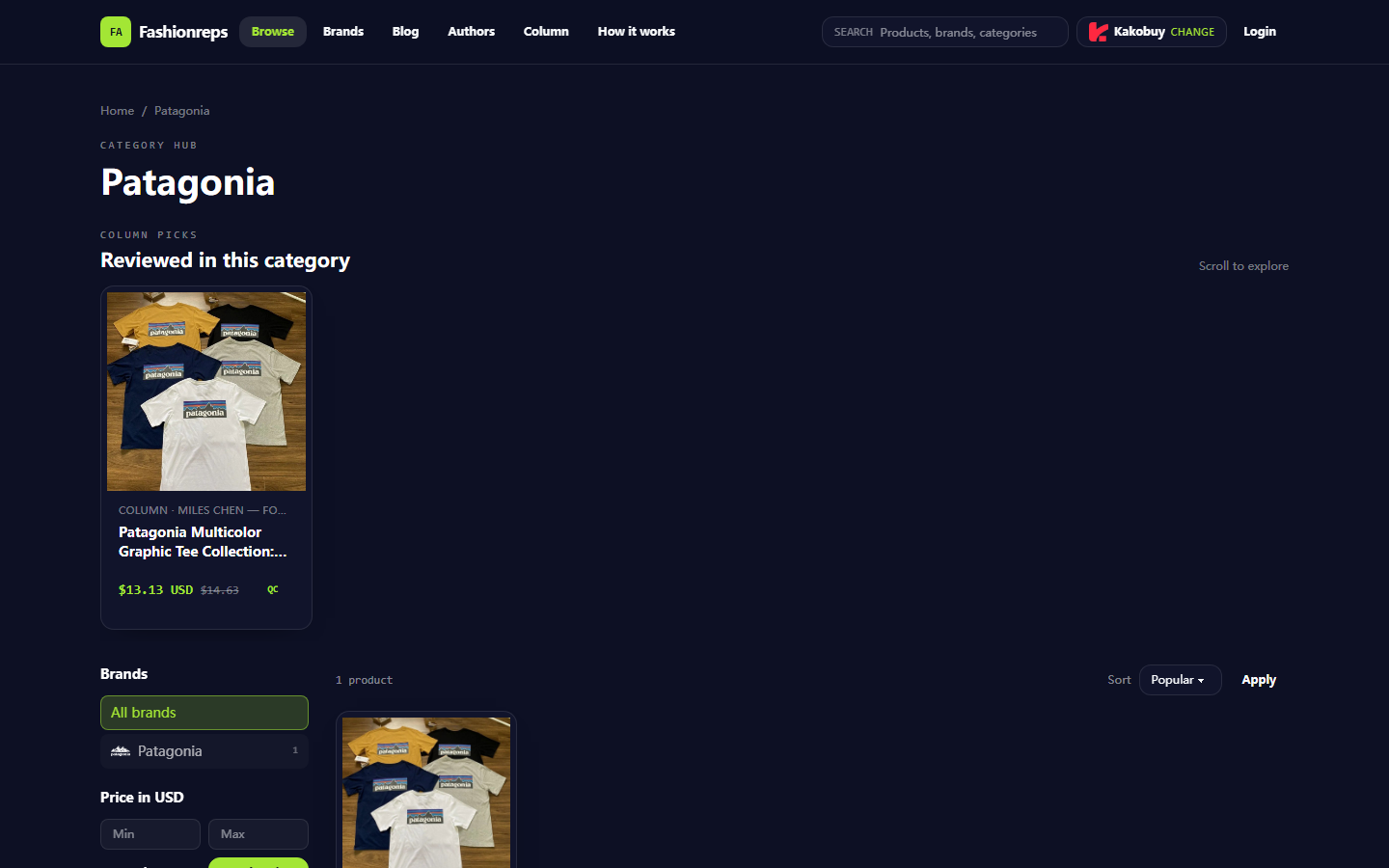
The currently verifiable Fashionreps page is the patagonia category page. The page displays a series of Patagonia multicolor graphic T-shirts, with a reference price of $13.13, a previous reference price of $14.63, and multiple color options. This price can only be used as a reference price shown on the product page, and cannot be directly considered as the final product price in the agent's order, nor can it replace warehouse storage, domestic shipping, service fees, international shipping, taxes, or exchange rate conversion.
The page also shows that Fashionreps' purchase button will direct users to their selected external shopping agent, and orders, payments, and shipping are handled by the agent's website. Therefore, the decision to ship individually or consolidated must be based on the order page, warehouse page, and official shipping calculator of the selected agent. The Fashionreps category page itself does not provide destination, chargeable weight, and route quotes sufficient to calculate the final package total.
This page verification date is 2026-10-23. The verification scope includes product names, page display prices, category status, agent selection entry, and platform responsibility boundaries; it does not verify real-time shipping costs, taxes, insurance, packaging fees, or agent settlement amounts for specific destination countries.🧾
Verify Candidate Products, Specifications, and Current Page Status from the fashionreps Catalog
First, save screenshots of the product page or category page, and record the following:
- Whether the product name is clearly the Patagonia multicolor graphic T-shirt series.
- Current display price, currency, and whether there is an old price comparison.
- Whether selectable colors, sizes, or other specifications are still visible.
- Whether the product page opens normally and has a clear purchase entry.
- Whether the page is just a brand category, tag page, or empty page.
- Whether the currently selected shopping agent is clearly identified.
The category page shows "1 product", which indicates that the visible catalog sample is limited, and cannot be used to infer the entire Patagonia product line, inventory quantity, or prices of other products. The reference price on the page should not be extended to an inventory commitment, quality guarantee, or final transaction price.
If you plan to consolidate multiple items, you must save the product name, specifications, page price, and corresponding link information for each item. Do not assume that different products have the same price, weight, packaging volume, or after-sales conditions just because they belong to the same brand.👕
Standardize Destination, Item Quantity, Packaging Method, and Chargeable Weight Parameters
Before comparing the two options, first fix the same set of variables:
- Destination country or region, and if necessary, state, province, or postal code.
- Shopping agent and specific international shipping route.
- Item quantity, specifications, colors, and order status of each item.
- Whether to keep original packaging, shoe boxes, hang tags, or other additional packaging.
- Whether to remove outer packaging, compress, reinforce, or repackage.
- Estimated actual weight, volumetric weight, and the chargeable weight ultimately used by the agent.
- Query time, quote currency, and exchange rate source.
For individual shipping, record the chargeable weight and fixed fees for each item when it forms a separate package. For consolidated shipping, use the new weight and volume after the warehouse completes consolidation. You cannot simply add up the individual shipping quotes and assume that is the consolidated quote, because consolidation may change packaging weight, volumetric weight, first weight structure, and route applicability.
If the agent only shows an estimated weight, mark it as "estimated" before settlement, not as final weight. If there is a re-weighing or additional payment after consolidation, keep the additional payment records.⚖️
Record Products, Services, and Payment Items Separately for Individual and Consolidated Shipping
It is recommended to record the two options separately to avoid mixing product payments and international shipping payments. At least the following items should be checked separately:
| Cost Item | Individual Shipping Needs Record | Consolidated Shipping Needs Record |
|---|---|---|
| Product Amount | Current order amount and currency for each item | Order amounts and currencies for all items included in consolidation |
| Agent Service Fee | Whether charged per order, item, or package | Whether consolidation incurs re-handling or extra service fees |
| Domestic Shipping | Seller to agent warehouse fees and whether paid | Whether domestic fees for each item are consolidated or still calculated separately |
| Packaging Fee | Individual packaging, reinforcement, or special handling fees | Consolidation, unpacking, removing packaging, repacking, and reinforcement fees |
| International Shipping | Route quote corresponding to individual chargeable weight | Route quote corresponding to actual or volumetric chargeable weight after consolidation |
| Payment and Exchange Rate | Payment fees, exchange method, and settlement rate | Same recording, and do not omit fees just because the amount is larger |
| Taxes and Insurance | Whether prepaid, cash on delivery, or completely excluded | Same confirmation, and check declared value and insurance conditions after consolidation |
Product amount is not equal to total package cost. You should separately save evidence of product order amount, agent service fee, domestic shipping fee, warehouse handling fee, packaging fee, international shipping fee, payment fee, exchange rate difference, taxes, and insurance. When an item does not appear on the quote page, mark it as "not shown" instead of defaulting to zero.
Use the Official Logistics Calculator to Check Routes, Chargeable Weight, Shipping Costs, and Transit Times
After selecting an agent, go to the agent's official logistics calculator or package settlement page, and calculate separately with the same destination and query time:
- Individual option: Enter each item separately, record route, weight bracket, shipping cost, estimated transit time, and restrictions.
- Consolidated option: Enter total weight, dimensions, product category, and declaration information after consolidation, record the same fields.
- Compare whether the two options use the same route; if routes differ, do not only compare amounts, but also compare transit time, tracking, prohibited items, and compensation conditions.
- Save calculator results, quote validity, and whether fuel surcharges, remote area fees, or other additional charges are noted.
If the calculator requires actual dimensions, and you only have item quantity or vague weight, do not output specific shipping costs. You should first complete warehouse weighing or confirm dimensions with the agent. The reference price on the page cannot be used to derive international shipping costs, because shipping costs usually depend on destination, route, chargeable weight, and packaging status.
Transit time can only be recorded as the estimated range shown by the calculator. Customs clearance delays, flight changes, destination country holidays, and requests for additional documents may all affect actual arrival time.🚚
Distinguish Between Packaging, Taxes, Insurance, Exchange Rates, and Unincluded Items
Consolidation may often reduce repeated first weight, repeated handling, or fixed costs from separate packaging, but it does not necessarily reduce total cost. If volumetric weight increases significantly after consolidation, or package value, declared amount, and single-loss risk increase, the saved shipping costs may be offset by other costs.
Also confirm the following separately:
- Packaging: Removing original packaging may reduce weight, but may also affect product protection, returns/exchanges, or platform handling conditions.
- Taxes: The destination country may charge taxes based on declared value, product category, and local rules; absence on the page does not mean tax-free.
- Insurance: Confirm coverage scope, compensation limit, exclusions, and declaration documentation requirements.
- Exchange rate: Record the exchange rate used at payment, platform conversion rate, and possible payment fees.
- Tracking: Confirm whether the route provides a usable tracking number, and from which node tracking information updates.
- Unincluded items: Mark items not appearing in the quote as "not included", not as zero.
When customs is involved, declare truthfully according to destination country rules, and confirm import restrictions and required documents. Do not create paper savings by under-declaring, splitting orders to avoid taxes, or evading inspection. If consolidation makes product category, declared value, or route restrictions unclear, pause consolidation and confirm with the agent.
Compare the Two Package Options Using the Same Currency and Query Time
When comparing, you can use the following formulas:
Individual Option Total Cost = Product Amount + Domestic Shipping + Agent Service Fee + Individual Packaging Fee + Individual International Shipping + Payment and Exchange Rate Costs + Known Taxes and Insurance.
Consolidated Option Total Cost = All Product Amounts + Domestic Shipping + Agent Service Fee + Consolidation and Repackaging Fee + Consolidated International Shipping + Payment and Exchange Rate Costs + Known Taxes and Insurance.
Only when both options use the same currency, same destination, same query time, and similar fee applicability conditions, is a direct comparison appropriate. If one amount is in US dollars and another in Chinese yuan, record the original currencies first, then convert using the same exchange rate; do not only look at individual numbers shown on the payment page.
The current evidence is insufficient to calculate specific savings for a certain destination, because destination, selected agent, chargeable weight after consolidation, route quote, taxes, and insurance conditions are not provided. What can be calculated is not "how much money will inevitably be saved", but the difference between the two options under the same quote conditions:
Consolidation Difference = Individual Option Total Cost − Consolidated Option Total Cost.
If the result is positive, it means consolidation cost is lower within known items; if the result is close to zero, risk and transit time may be more important than a small price difference; if negative, shipping separately is lower under current quote conditions. Any unincluded fees should be listed separately in the conclusion.💱
Save Page Evidence and Decide to Proceed with Consolidation, Ship Separately, or Do Additional Verification
It is recommended to create a pre-payment record that at least includes product page screenshots, product order amounts, agent name, destination, item quantity, packaging choices, individual and consolidated weights, routes, shipping costs, service fees, payment fees, exchange rates, tax notes, insurance conditions, query time, and quote validity. For screenshots involving order numbers, addresses, phone numbers, payment information, or complete waybills, first redact personal information and do not publicly share complete vouchers.
You can make decisions based on the following conditions:
- Proceed with consolidation: Official consolidated quote is clearly lower than the individual option, chargeable weight is confirmed, route restrictions are acceptable, tax and insurance conditions are clear, and you can accept the risk of a single package being lost or damaged all at once.
- Ship separately: Volumetric weight increases significantly after consolidation, route restrictions or declaration issues become complicated, individual item value is high, or different items have different after-sales and transit time needs.
- Additional verification: Only estimated weight, missing destination, no official calculator result, incomplete fee items shown, or agent has not confirmed consolidation packaging method.
Consolidation may save repeated first weight, repeated handling fees, or some packaging costs; increased risks may include volumetric weight changes, concentrated single loss, increased declaration complexity, tax changes, and inconvenient after-sales handling. It is more suitable for buyers whose product specifications are clear, weight and route are confirmed, and who can accept a unified arrival time. It is not recommended to decide consolidation based solely on category page display prices when destination, chargeable weight, route quote, or tax conditions are missing, nor to sacrifice truthful declaration, insurance conditions, or traceability for the sake of paper savings.