 Daniel Vos
What This Fee Verification Covers When buying an Omega-style watch, the item price on the page is just the starting point. What you really need to verify are the item price, service fees, payment processing fees, packaging costs, international shipping, exchange rate differences, and possible taxes or customs clearance costs in the destination country. This article focuses on the Omega Smart-Casual Seamaster Dive Watch visible on the Fashionreps page, helping you
Editor score 4.2 / 5
What This Fee Verification Covers
When buying an Omega-style watch, the item price on the page is just the starting point. What you really need to verify are the item price, service fees, payment processing fees, packaging costs, international shipping, exchange rate differences, and possible taxes or customs clearance costs in the destination country. This article focuses on the Omega Smart-Casual Seamaster Dive Watch visible on the Fashionreps page, helping you create a reviewable fee record before submitting your order.
The verification date for this article is October 13, 2026. The visible product name on the target page is Omega Smart-Casual Seamaster Dive Watch, SKU SPU-7FOCKZMDZU, and it shows that QC images can be viewed. The page itself does not equal the final shopping cart or international shipping quote, so you cannot derive current price, stock, service fees, exchange rates, or shipping times from it. ⏱️
After reading, you should be able to do three things: record fees from different stages separately, determine whether the warehouse weight matches the chargeable weight, and set a bounded budget when real-time rates are missing, rather than mistaking an estimate for the final amount due.
This method does not apply to situations where a complete checkout page has already been generated and you need to verify a specific order amount. In that case, you should rely on the order details, payment page, and shipping quote from the corresponding shopping agent.
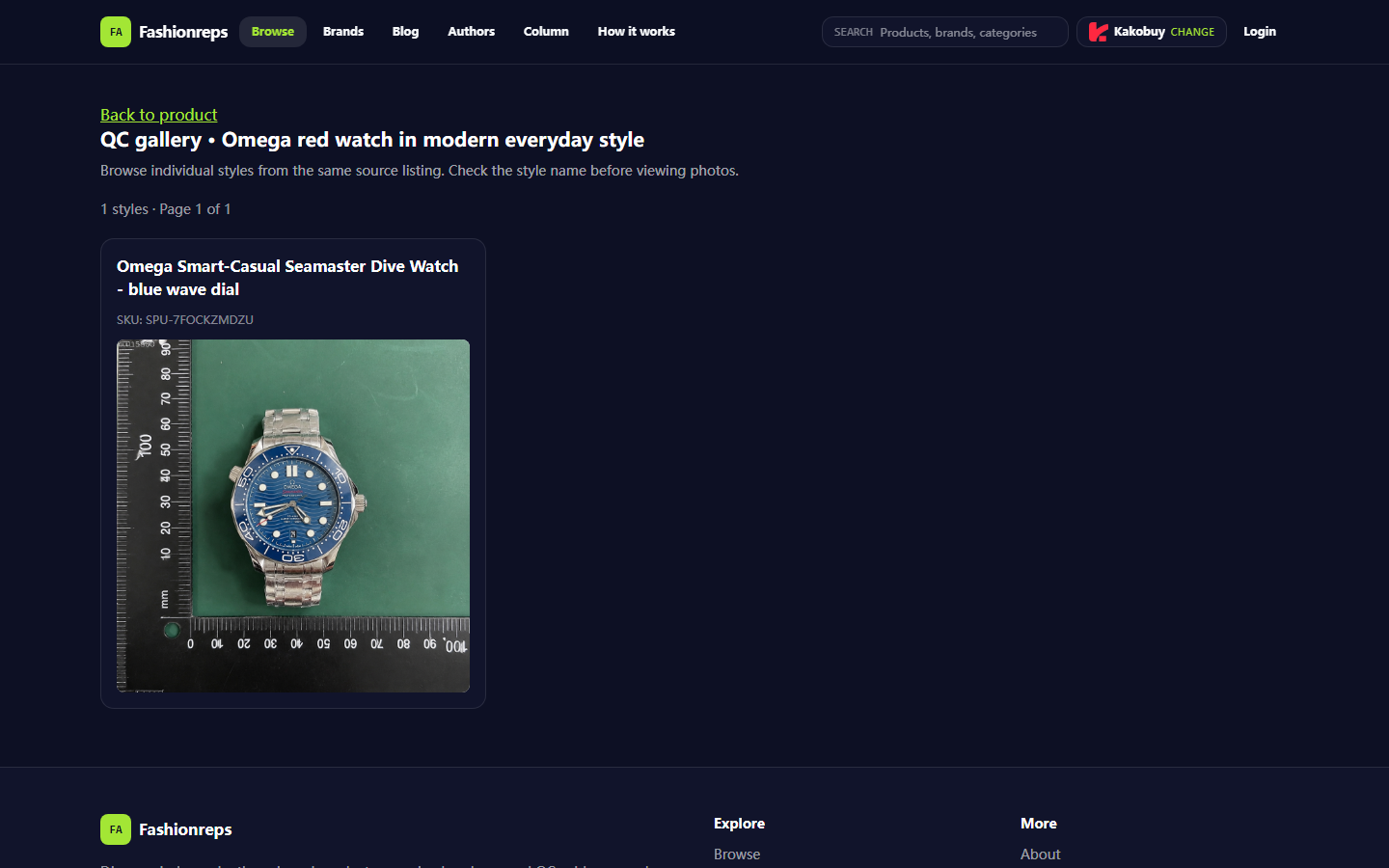
Watch Information to Confirm on the Target Site Product Page
Before placing an order, save the visible information from the product page and QC page. For watches, similar names may correspond to different dials, straps, sizes, packaging, or seller listings. Do not determine the specific configuration based solely on appearance in images, and do not treat QC images as proof of materials, movement, functions, or water resistance.
It is recommended to record item by item:
- The full name, SKU, or model number displayed on the product page.
- The selected color, dial style, strap style, and quantity.
- Whether the page clearly states dimensions, materials, functions, or included accessories.
- The currency of the item price, the time the page was viewed, and the corresponding variant.
- Whether there is a separate seller service fee, agent service fee, or order processing fee.
- Whether the QC images correspond to the selected style, not other styles from the same source.
- Whether the page indicates stock, pre-sale, out-of-stock, or requires manual confirmation.
The QC area on the current sample page shows 1 viewable style, named Omega Smart-Casual Seamaster Dive Watch. This information can only be used to confirm the page object, not to replace real-time verification of product specifications, price, and shippable status. 🔎
How to Record Exchange Rates and Payment Processing Fees
The most common mistake in exchange rate accounting is mixing the product page currency, agent account settlement currency, card billing currency, and final bill currency into one number. It is recommended to first determine the currency you actually pay in, then record the conversion method used by the payment channel.
You can use the following record structure:
| Fee Item | What to Record | What Not to Assume |
|---|---|---|
| Item price | Page amount, original currency, style, and quantity | Whether the page amount already includes agent service fees |
| Agent service fee | Fee name, calculation base, currency, and settlement time | Whether it is charged based on item price, order total, or parcel handling |
| Payment processing fee | Payment method, fee description, fixed fee, or minimum charge | Whether the bank or third-party payment institution adds extra charges |
| Exchange rate | Quote source, query time, buy or settlement direction | Whether the page rate equals the actual card billing rate |
| Taxes and customs | Destination country, declaration rules, and applicable conditions | Whether they will definitely be charged, or which party collects them |
When calculating, keep the original currency amount first, then convert to local currency separately. Do not record only a rounded total, otherwise you cannot tell later whether the difference comes from exchange rate, fees, or shipping.
If the payment page shows an instant conversion amount, save the conversion result and time before payment. The final amount on your card statement may be affected by the posting date exchange rate, foreign transaction fees, card issuer rules, or payment platform policies. Without real-time exchange rates and payment fees, you can only write "settled according to the actual amount on the payment page", not fill in unverified specific numbers. 💳
How to Distinguish Weight, Dimensions, and Chargeable Weight
Parcel fees usually don't just look at the watch's actual weight. Warehouse weighing may include the item, watch box, protective materials, outer box, and other combined items; carriers may also charge based on volumetric weight. Therefore, when you see a weight figure, first confirm which type it is:
- Net weight: only the weight of the item itself.
- Packed actual weight: the weighing result of the item plus packaging.
- Parcel actual weight: the actual weight of the entire outbound package.
- Volumetric weight: the chargeable basis calculated from length, width, height, and carrier formula.
- Chargeable weight: the weight ultimately used by the carrier for quoting, which may be the higher of actual or volumetric weight, subject to route rules.
If the watch comes with a large display box, wooden box, or extra protective packaging, the package volume may significantly affect billing. If combined with other items, you need to review total dimensions and total weight again, and cannot directly use the single item's weighing result as the final shipping cost basis.
It is more useful to request the warehouse or agent to provide: package length, width, height, packed actual weight, whether volumetric weight exists, billing unit used, route name, and whether the quote includes fuel surcharges or other handling fees. Without these fields, mark the shipping cost as pending confirmation instead of applying old order prices.
Packaging and International Shipping Condition Verification
For watches, packaging choices may affect protection, volume, and declaration information simultaneously. Reinforced packaging may reduce the risk of cosmetic damage during transit but may also increase package size; removing the original box or using lightweight packaging may reduce volume but change product protection, receiving experience, and evidence for after-sales claims.
Before ordering, confirm:
- Whether the product box, display box, or brand-related packaging is kept by default.
- Whether extra shockproofing, outer box reinforcement, or moisture-proofing options are available.
- Whether packaging services are charged per order, item, parcel, or weight.
- Which destination country, region, and postal code range the shipping quote applies to.
- Whether the quote uses actual weight, volumetric weight, or the higher of the two.
- Whether it includes remote area surcharges, fuel surcharges, re-delivery fees, or storage fees.
- Who bears the cost if the parcel is returned, address changed, or additional information is needed.
The Fashionreps page serves as an entry point for product discovery and shopping agent selection; order, payment, and shipping are handled by the selected agent's website. Therefore, product browsing information on the page cannot replace the shipping conditions on the agent's checkout page. Before final decision, at least obtain the route, destination, weight, and quote time from the agent's side.
How to Set Estimation Boundaries When Real-Time Rates Are Missing
Without real-time rates, you can budget, but don't create a seemingly precise total. A reasonable estimate should be broken into verifiable ranges and clearly indicate which items are still unquoted.
Recommended order:
- Fix item price: record page currency, quantity, and specific variant.
- List service fees separately: confirm if agent, handling, or storage fees exist.
- List payment costs separately: note whether payment method and fees are confirmed.
- Do not lock international shipping yet: wait for packed actual weight, dimensions, and route quote.
- List exchange rate risk separately: keep original currency amount and explain conversion time and source.
- Mark destination taxes: verify according to local applicable rules, do not state taxes as definitely occurring or not occurring.
If packed weight and dimensions are missing, the budget can only cover the item and known fees, and cannot claim to include final delivered cost. If destination country and postal code are missing, you cannot determine route surcharges or customs conditions. If the payment channel's fee rules are not disclosed, mark it as an unverified item.
Do not lower the budget by under-declaring, splitting orders to avoid taxes, or evading inspections. Declaration contents, import restrictions, taxes, and required documents should be verified according to destination country rules and carrier requirements. 🧾
Pre-Order Fee Verification Checklist
Before submitting your order, confirm item by item:
- I have saved the product name, SKU, style, quantity, and page verification time.
- I have confirmed the original currency of the item price and did not treat the converted amount as the original price.
- I know whether agent service fees exist and their calculation base.
- I know what currency the payment page uses and whether payment fees are displayed.
- I have recorded the exchange rate source and query time, and kept the original currency amount.
- I have distinguished net weight, packed actual weight, volumetric weight, and final chargeable weight.
- I have obtained shipping conditions for the destination country, region, or postal code.
- I have confirmed whether packaging, reinforcement, box removal, or consolidation choices will change weight and volume.
- I have not used shipping costs from old orders, other routes, or other items as current quotes.
- I understand that taxes, customs documents, import restrictions, and return handling still need to be confirmed according to destination country rules.
- I know which amounts are locked and which must wait for warehouse weighing or checkout page confirmation.
Final Decision and Next Steps
For this Omega-style watch, the safest decision is not to chase a lowest estimate first, but to confirm the product variant and QC object, then obtain packed weight, dimensions, destination route, and real-time settlement details. Only when item price, service fees, payment fees, packaging fees, international shipping, and exchange rate conversion are each traceable does the budget have comparative value.
Consolidation may reduce repeated first weight or handling costs, but may also increase volumetric weight, parcel value, and single loss risk. Splitting may increase fixed fees, but is easier to manage when route restrictions, value control, or product attributes differ. Actual savings must be calculated from the difference before and after the agent's quote, not filled in by experience.
Those suited for consolidation are people who already have multiple orders, can obtain unified weighing and route quotes, and are willing to bear the risk of increased single parcel value. Situations not recommended for consolidation include: package volume significantly increased, route restrictions on declaration or category, unacceptable single loss risk, or the agent cannot provide clear weight and fee details.
Next, do only three things: save the target product and QC pages, request packed actual weight and dimensions from the selected agent, and before payment, recheck the settlement page's currency, fees, shipping, and applicable conditions. If any of these items is still blank, mark the order as pending verification instead of finalizing the decision with unconfirmed numbers.