 Daniel Vos
If you're looking at a moncler winter jacket on fashion-reps, the first step isn't deciding if it's "warm enough"—it's confirming what verifiable information the listing actually provides. This article walks you through a pre-purchase checklist based on the page's visible data: identify the style, note fabric and appearance evidence, assess whether sizing info is sufficient, and decide whether to ask more questions, wait for more details, or hold off. 🔎
Editor score 4.2 / 5
If you're looking at a moncler winter jacket on fashion-reps, the first step isn't deciding if it's "warm enough"—it's confirming what verifiable information the listing actually provides. This article walks you through a pre-purchase checklist based on the page's visible data: identify the style, note fabric and appearance evidence, assess whether sizing info is sufficient, and decide whether to ask more questions, wait for more details, or hold off. 🔎
This guide does not apply to authenticating the item, predicting performance in extreme cold, or replacing checks on import, tax, and after-sales policies in your destination country. fashion-reps is responsible for displaying product information and QC references; the actual ordering, payment, and shipping arrangements must still be made through your chosen shopping agent. The information on this page was verified on October 17, 2026.
Defining the Scope for Evaluating a moncler Winter Jacket Listing
The current QC page shows the item is categorized as "Moncler jacket in black nylon," with the style name listed as "Long Puffer Coat in Black by Moncler" and SKU SPU-CHOC2LJLGX. The page indicates 1 style from this source and provides a QC gallery link.
This information supports the following conclusions:
- You're looking at a black long jacket or long puffer style, not a full range of colors and fits.
- The listing at least provides a style name, color or appearance description, SKU, and QC image access.
- The listing can be used for initial screening, but is not enough on its own to prove authenticity, warmth level, fill weight, or long-term durability.
Therefore, the goal of evaluation should be limited to "does this item have enough evidence to proceed to the next step of verification," not to directly give a warmth guarantee or brand authenticity conclusion. 🧭
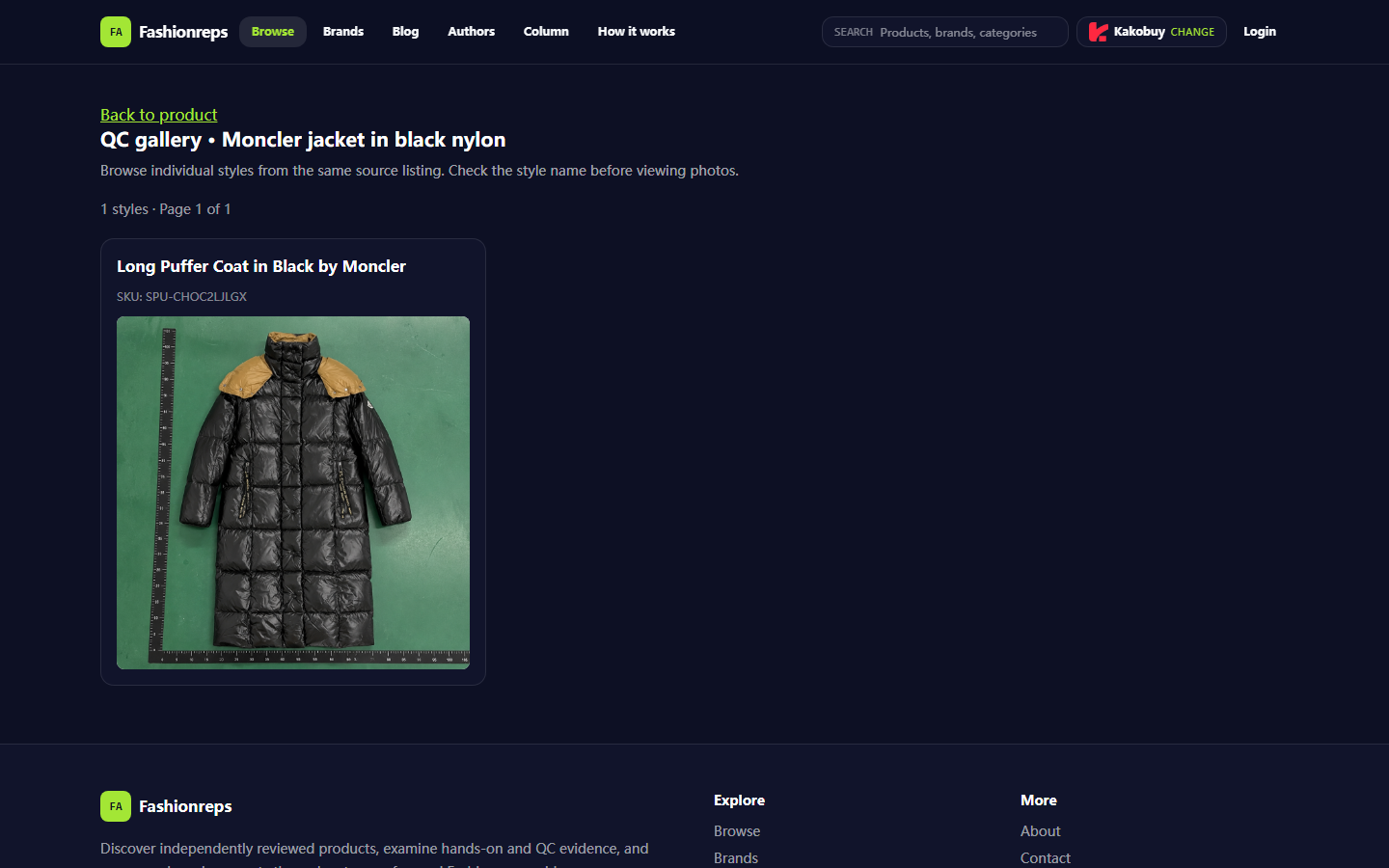
Image: QC reference image of the moncler black nylon long jacket provided on the page.
Recording Visible Style, Fill, or Fabric Descriptions and Images
The page currently clearly shows a black nylon appearance description and a long puffer style name. Here we need to separate "what the page says" from "what buyers infer."
| Check Item | Visible Info on Page | Current Conclusion |
|---|---|---|
| Style | Long Puffer Coat in Black by Moncler | Identifiable as a black long jacket style |
| Appearance or Fabric Description | black nylon | Can be recorded as a black nylon appearance or fabric description |
| Fill Information | No clear fill material or weight in page summary | Cannot confirm down, synthetic fill, or warmth level from this |
| Image Evidence | QC gallery | Useful for checking appearance details, but not a substitute for material testing |
| Number of Styles | 1 style | Should not assume other colors or fits exist |
"Puffer" typically describes the garment's quilted structure or appearance and does not automatically indicate the type of fill. If the listing does not list fill material, fill ratio, fill weight, fabric composition, and care requirements, mark those items as needing verification rather than substituting brand name or appearance for answers.
When viewing images, note whether quilting is continuous, left-right symmetry, presence of hood and placket, visibility of zipper and cuffs, and whether images cover front, back, and key details. Images only show what is visible in the frame; unclear areas should be marked as "cannot confirm." 📷
Checking Whether Sizing, Fit, and Layering Space Have Clear Evidence
The risk of buying a long winter jacket is usually not just length, but also shoulder width, chest, sleeve length, hem width, and layering space. If the page only shows letter sizes like S, M, L without centimeter or inch measurements, it is not enough to judge whether it will fit your body type.
It is recommended to compare the listing's size chart with a winter coat you already own and that fits well, laid flat, recording at least:
- Shoulder width
- Chest or underarm width
- Jacket length
- Sleeve length
- Hem width
- Whether hood or high collar structure affects neck space
If you plan to wear a hoodie, knit, or thermal layer inside the jacket, do not choose based on body measurements alone. Compare "garment measurements" with "existing coat measurements" and leave room for movement. For long styles, excessive length may hinder getting in and out of cars or stairs, while too short may lose coverage of the waist and hips; this is a fit adaptation issue, not equivalent to warmth performance.
If the listing lacks a clear size chart, measurement method, or flat measurements, ask the agent or seller for specific measurements and confirm the margin of error. Do not rely solely on model photos, brand's typical sizing, or a single height/weight example in reviews to decide size. 📏
Separating Appearance Details, Specification Facts, and Editorial Inference
When reading a listing, information can be divided into three layers:
First layer: facts directly visible or transcribable, such as black color, nylon description, long style name, SKU, and presence of zipper and pockets in images. These can be recorded as page notes.
Second layer: specifications that must be explicitly provided by the page or seller, such as fill material, fill weight, fabric ratio, size measurements, care instructions, production batch, and return/exchange conditions. If the page does not state them, keep them as unknown.
Third layer: editorial inference, such as "might be suitable for commuting," "looks like it has some wind resistance," or "might be suitable for cold weather." Such judgments can only be based on clear structure, measurement data, weather conditions, and layered wear, and must use cautious language.
For example, a black nylon surface can support "the page describes it as black nylon," but cannot directly support "waterproof," "windproof," or "abrasion-resistant." A long and puffy appearance can support "may provide more coverage," but cannot directly support "suitable for sub-zero temperatures." 🧥
Breaking Down Use Scenarios by City Commute and Short Trips
If you mainly use it for city commuting, prioritize verifying length, range of motion, placket structure, cuff tightness, and portability. Subways, offices, and malls often involve frequent indoor-outdoor transitions; overly thick or long styles can affect storage and movement. Only when the page or seller provides sufficient material and structure information can you further judge if it suits your winter layering needs.
If you use it for short trips, additionally confirm weight, compressed volume, hood and pocket structure, and cleaning and care requirements. Travel involves frequent scene changes; a too-tight size limits layering, while an overly loose one increases luggage space. Without weight and storage info, do not interpret "puffy" as "easy to carry."
For humid, windy, or highly variable climates, warmth judgment also needs to consider base layers, pants, shoes, activity level, and duration outdoors. A jacket listing alone cannot cover the full wearing environment, so suitability scenarios can only be conditional judgments, not guarantees.
Not Treating Product Descriptions as Warmth Guarantees or Authenticity Proof
The presence of moncler in the product name or brand-like appearance cannot alone prove authenticity. QC images help buyers check visible appearance and workmanship clues; they are not official authentication reports and cannot prove material source, production chain, or after-sales eligibility.
Similarly, the word "puffer" or a puffy look cannot replace the following information:
- Fill type and ratio
- Fill weight or grammage
- Fabric composition and functional treatments
- Specific construction of seams, placket, and cuffs
- Applicable temperature or testing standards
- Actual size measurements
If this information is missing, the reasonable conclusion is "insufficient evidence, needs verification," not "the product is definitely bad" or "the product is definitely warm enough." This boundary is especially important because ordering, payment, agent services, logistics, and after-sales may all incur actual costs. ⚠️
Verification Checklist When Material, Size, or Detail Info Is Missing
Before deciding to purchase, you can ask the shopping agent or seller a set of specific questions, requiring item-by-item answers:
- What is the fill? Can you provide fill ratio or fill weight?
- Is the fabric nylon? Are there other blends or coatings?
- Is there a size chart in cm or inches? What are the measurement points and margin of error?
- Can you provide photos of front, back, cuffs, zipper, pockets, labels, and lining?
- Are there multiple colors or versions? Which SKU do the current images correspond to?
- What after-sales conditions apply if the size is wrong, there are obvious flaws, or it doesn't match the description?
When requesting additional photos, specify exact areas and angles instead of just saying "take clearer photos." If supplementary photos still fail to show key details, or answers remain vague, keep the uncertainty in your purchase decision.
Final Pre-Purchase Verification and Conditions to Hold Off
Before placing an order, go through this final checklist:
- Check that style name, color, SKU, and images correspond to each other.
- Check whether the size chart includes actual measurements and compare with your own coat's measurements.
- Confirm which of the fill, fabric, weight, and care information are verified and which are still unknown.
- Check whether QC images cover front, back, and key details; do not rely on a single main image.
- Understand the shopping agent's payment, inspection, return/exchange, and international shipping terms.
- Itemize costs: product price, agent service fee, domestic shipping, international shipping, insurance, taxes, and possible return costs.
Consider holding off if: size data is missing and cannot be supplemented, key material or fill info is completely unknown, images do not match the product name or SKU, seller refuses to provide necessary details, or you need definite extreme cold performance but the page has no verifiable basis.
For those with complete information, matching size, and clear use scenarios, this listing can serve as a starting point for further inquiries and QC verification. For those needing authenticity proof, extreme weather guarantees, or full after-sales commitments, you should not complete the purchase decision based solely on the current page. This may cause you to miss a seemingly cheap deal, but it can reduce costs from wrong size, mismatched use, insufficient evidence, and after-sales disputes.