 Daniel Vos
First, confirm what fee you are checking When returning ERD watch accessories, the most common error is not a miscalculation, but inconsistent input conditions. Keeping the original packaging may change the package's actual weight, dimensions, or chargeable weight, but the product name alone cannot determine whether the final shipping cost will increase. You should first fix the product, packaging, destination, and route conditions, then query the fee.
Editor score 4.2 / 5
First, confirm what fee you are checking
When returning ERD watch accessories, the most common error is not a miscalculation, but inconsistent input conditions. Keeping the original packaging may change the package's actual weight, dimensions, or chargeable weight, but the product name alone cannot determine whether the final shipping cost will increase. You should first fix the product, packaging, destination, and route conditions, then query the fee.
The currently verifiable Fashionreps ERD page shows the ERD T-shirt category with 2 products and corresponding reference prices; the page does not provide product information for watch accessories, nor does it provide packaging dimensions, weight, inventory, or international shipping costs for watch accessories. Therefore, you cannot apply the clothing prices or other accessories' logistics quotes from the page to this package.
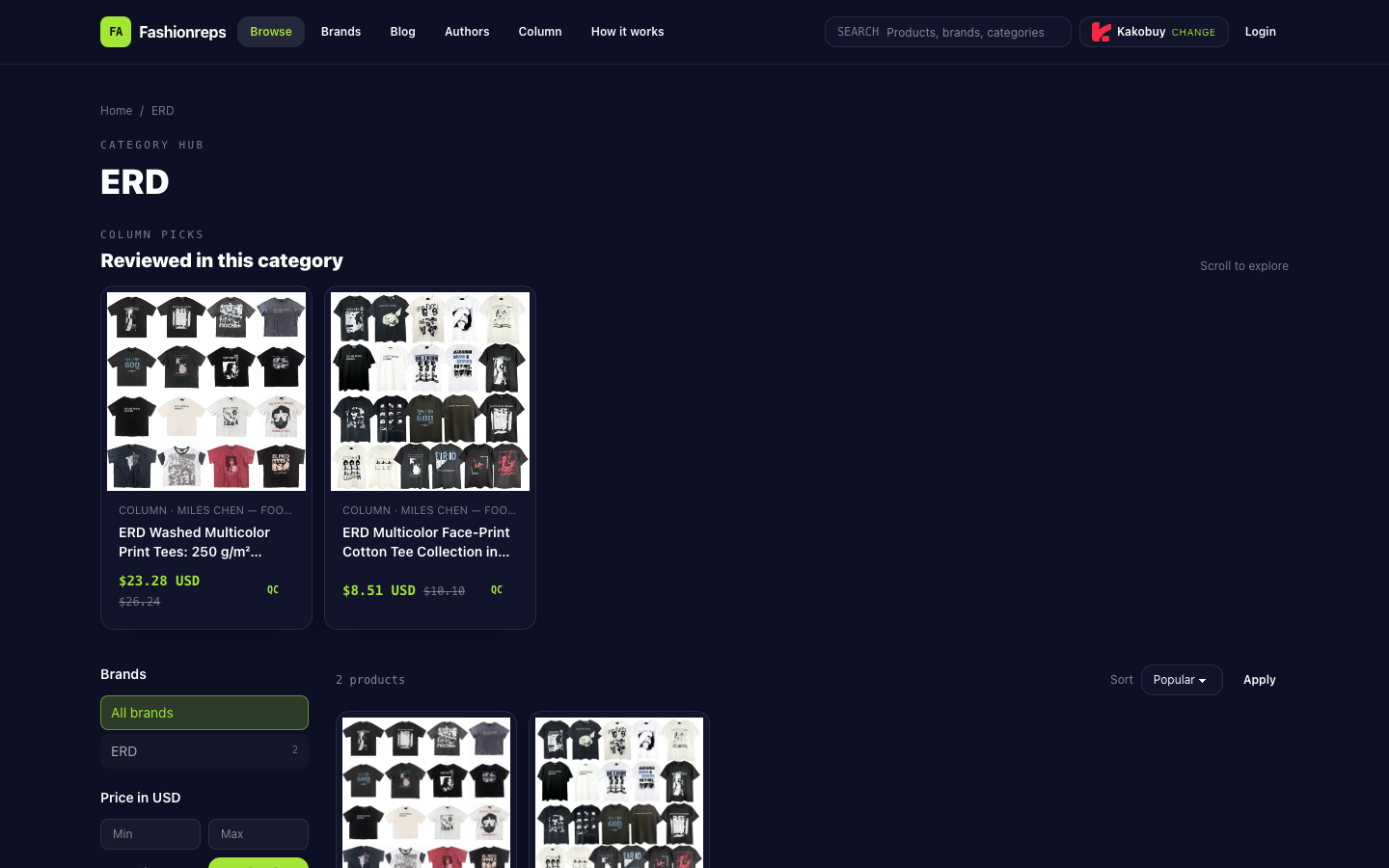
Page screenshot: The currently verifiable source shows the ERD product category page, not physical watch accessories or packaging evidence.
What check conditions does packaging retention affect
Keeping packaging is not an independent billing conclusion; what really matters is whether it changes the following conditions:
- Whether the actual weight after warehousing increases.
- Whether the package length, width, and height change.
- Whether the agent uses actual weight, volumetric weight, or the higher of the two as the chargeable weight.
- Whether additional packaging, reinforcement, or repacking fees are incurred.
- Whether the packaging is part of the product itself, seller packaging, or removable external material by the warehouse.
- Whether the destination and available routes change due to package size or category restrictions.
If the warehouse has not yet completed inbound weighing and measurement, you cannot reliably judge the international shipping cost after keeping packaging. In this case, only record pending conditions and do not write specific amounts in advance.
Create a unified package record
Before querying different packaging options, establish a fixed record. Change only one variable at a time, for example, only compare "keep original packaging" and "remove external packaging", do not simultaneously change route, destination, or currency.
| Item | Recording method |
|---|---|
| Product | Accurate name, variant, and quantity of ERD watch accessories |
| Packaging option | Keep, remove, or repack, and specify the scope |
| Weight | Based on actual warehouse weighing results, record units |
| Dimensions | Record package length, width, height, and measurement time |
| Destination | Country, region, or postal code, keep consistent for each query |
| Route | Record route name and applicable restrictions, do not use "ordinary route" instead |
| Currency | Record the currency shown on the calculator or checkout page |
| Query time | Record date and time, as rates may change |
Product quantity should also be fixed. Single accessories, multiple accessories consolidated, and combined with other products may correspond to different weight, volume, and category restrictions, and results cannot be mixed.
Check each fee item one by one
The final cost should be recorded separately, not just copying a total price. It is recommended to check in the following order:
- Product price: Fill in only the amount clearly displayed on the current product page or agent order page, and note the currency. When the source page does not have a product price for watch accessories, stop filling in specific values.
- Service fee: Confirm whether the agent charges separate fees for purchasing, handling, or warehousing. When there is no official fee detail, do not estimate based on proportions from other orders.
- Payment fee: Check whether the checkout page shows payment processing fees, recharge fees, or exchange fees, and distinguish whether they are included in the total price.
- Packaging fee: Confirm whether keeping original packaging, unpacking, reinforcement, or repacking incurs additional fees. When there is no corresponding service page or checkout item, mark as pending.
- Exchange rate: Record the currency and conversion method used on the checkout page. Do not treat a bank card bill's exchange rate as the fixed rate for all orders.
- Chargeable weight: Refer to the official calculator instructions to confirm whether actual weight, volumetric weight, or the higher one is used. When route rules are missing, do not apply volumetric weight formulas to derive shipping costs.
- International shipping fee: Only use the results from the agent's official calculator or actual checkout page, and save destination, packaging option, weight, dimensions, route, and query time simultaneously.
- Taxes and insurance: Check whether they are listed separately on the checkout page or route description. Without destination and route evidence, do not assert that they are included or excluded.
Correct comparison method for two packaging options
If the warehouse provides actionable packaging options, you can do a controlled comparison:
- Option A: Keep original packaging, record actual weight, dimensions, chargeable weight, and available routes.
- Option B: Remove removable external packaging, re-measure the same set of data.
- Keep other conditions unchanged: product quantity, destination, currency, query time as consistent as possible.
- Save calculator results or checkout page screenshots separately, avoid only recording manually transcribed totals.
- If route, insurance, or tax conditions change with packaging options, mark the changes separately, do not only compare shipping fee numbers.
Only after obtaining official page values for both options can you judge which option is more suitable. If one option lacks weight, dimensions, route, or rate evidence, stop comparing specific amounts and state that comparable conditions are not yet met.
When should you keep packaging
Without current route quotes, you cannot simply assert that keeping packaging is cheaper or safer. You can make conditional judgments based on confirmed information:
- If packaging is necessary for product integrity or accessory protection, first confirm whether removal affects inspection, return, or shipping risk.
- If packaging is just external volume material, ask the warehouse if removal is allowed and whether reinforcement will be done after removal.
- If keeping packaging significantly increases volume, focus on the route's volumetric billing rules, not just product weight.
- If unpacking triggers repacking fees, reinforcement fees, or other service fees, compare these fees with possible shipping cost reductions.
- If the agent does not provide clear packaging options or route rules, keep records and wait for official checkout conditions, do not substitute experience from other products.
Conclusion: Get four sets of data first, then judge fees
To judge ERD watch accessory return shipping costs, at least product information, inbound actual weight, package dimensions, destination, and route conditions under the same packaging option are needed. Whether to keep packaging can only be compared through two sets of unified parameters and the official calculator or actual checkout page.
Currently verifiable data is insufficient to support specific product prices, inventory, packaging fees, international shipping fees, taxes, or final total prices for watch accessories. After inbound, complete the record with weight and dimensions; when selecting a route, save the fees shown on the official calculator or checkout page. If any critical condition is missing, pause making specific amount judgments.